Climate Justice
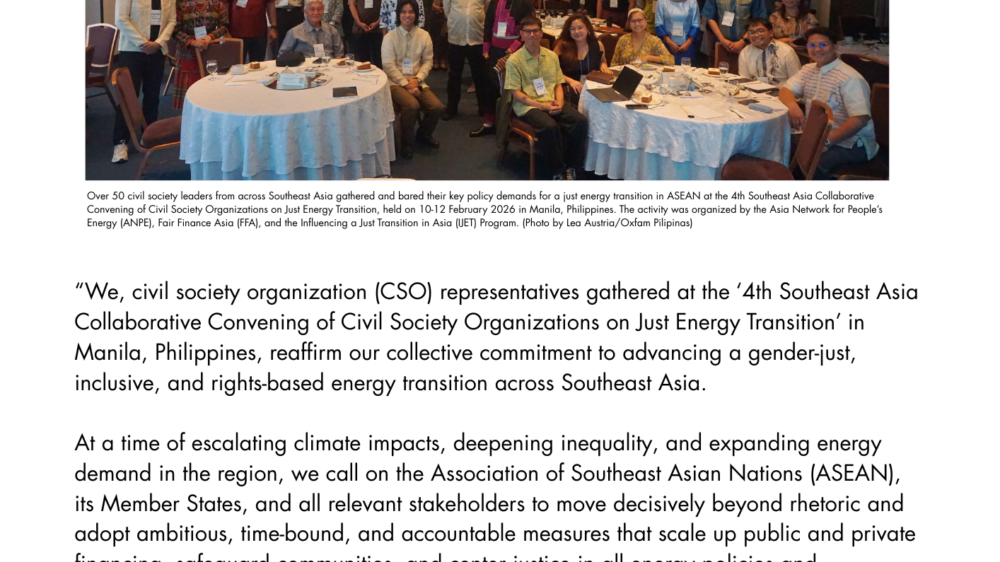
COMMUNIQUE: 4th Southeast Asia Collaborative Convening of Civil Society Organizations on Just Energy Transition
Civil society groups from Southeast Asia called on the Association of Southeast Asian Nations (ASEAN) member states and their energy ministers to “open their hearts to justice by putting people and gender equality at the center of energy governance and planning for a just and inclusive energy transition (JET) in the ASEAN region”.
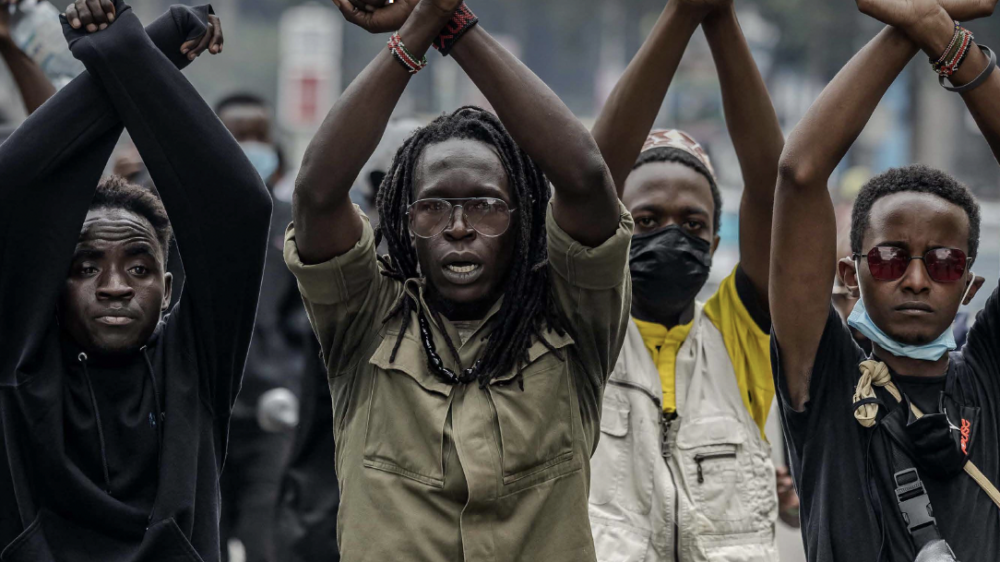
Resisting the Rule of the Rich: Protecting Freedom from Billionaire Power
Billionaire fortunes have grown at a rate three times faster than the previous five years. The number of billionaires has surpassed 3,000 for the first time, and the level of billionaire wealth is now higher than at any time in history. Meanwhile, globally, one in four people face hunger.
Guiding ASEAN’s Just and Inclusive Energy Transition: ANPE’s Statement on the APAEC 2026-2030
The Asia Network for People’s Energy (ANPE) congratulates the ASEAN Member States and the ASEAN Centre for Energy (ACE) on the publication of the new ASEAN Plan of Action for Energy Cooperation (APAEC) 2026–2030 last 15 October 2025.
Socially Accountable Governance in Just Energy Transition (Interactive)
This report examines progress, gaps, and opportunities that exist in the intersections of governance, justice, and energy transition in Southeast Asia by examining the role of Social Accountability (SAcc) in utility-scale energy transition projects. Download this compressed interactive copy. The report is also available in full resolution and through an executive summary.
Socially Accountable Governance for Just Energy Transition
This report examines progress, gaps, and opportunities that exist in the intersections of governance, justice, and energy transition in Southeast Asia by examining the role of Social Accountability (SAcc) in utility-scale energy transition projects.
Climate Plunder: How a powerful few are locking the world into disaster
The report, Climate Plunder: How a powerful few are locking the world into disaster, presents extensive new updated data and analysis which finds that a person from the richest 0.1% produces more carbon pollution in a day than the poorest 50% emit all year. If everyone emitted like the richest 0.1%, the carbon budget would be used up in less than 3 weeks.
Climate Finance Shadow Report 2025: Analysing progress on climate finance under the Paris Agreement
The Climate Finance Shadow Report presents analysis of North-South climate finance flows and assessing progress towards the $100 billion commitment to inform climate finance under the New Collective Quantified Goal (NCQG). Oxfam reported on the progress of this commitment in 2016, 2018 and 2020 and 2023. This year’s report, which is co-published by Oxfam and […]
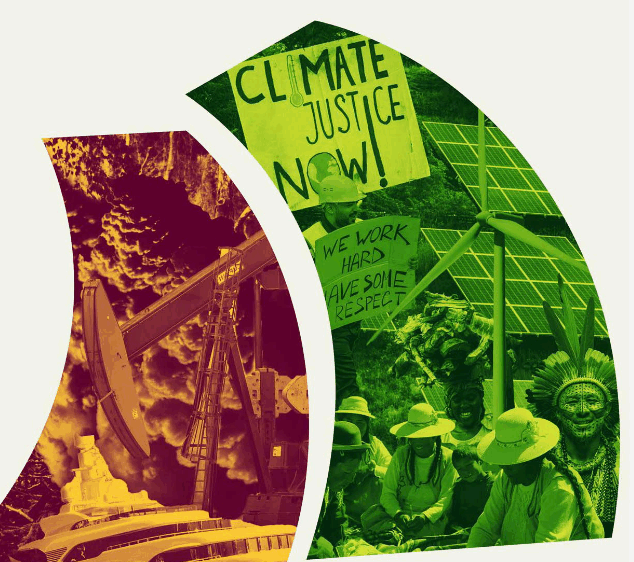
Unjust Transition: Reclaiming the energy future from climate colonialism
The global energy transition stands at a pivotal moment: it can either dismantle the inequalities driving the climate crisis or deepen them. Today, the transition risks reproducing patterns of extractivism and exploitation, with the most marginalized paying the highest price while elites profit. From transition mineral mining to debt burdens and unequal energy access, the […]
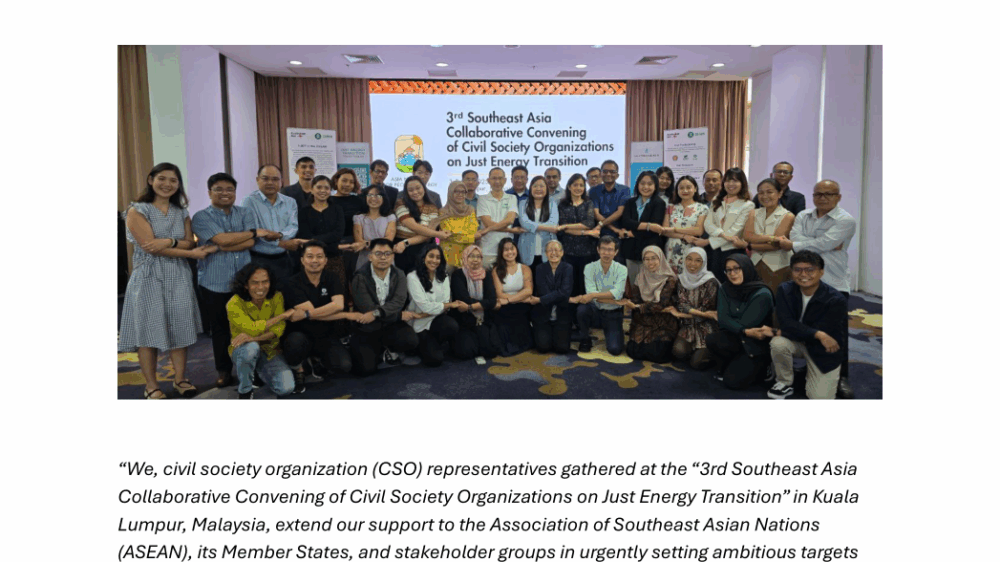
COMMUNIQUE: 3rd Southeast Asia Collaborative Convening of Civil Society Organizations on Just Energy Transition
The communique contains key asks of CSOs to ASEAN's Ministers of Energy and the 2025 ASEAN Malaysia Chairpersonship that aim to prioritize GJIET as a pillar in the updating and development of APAEC 2026-2030.
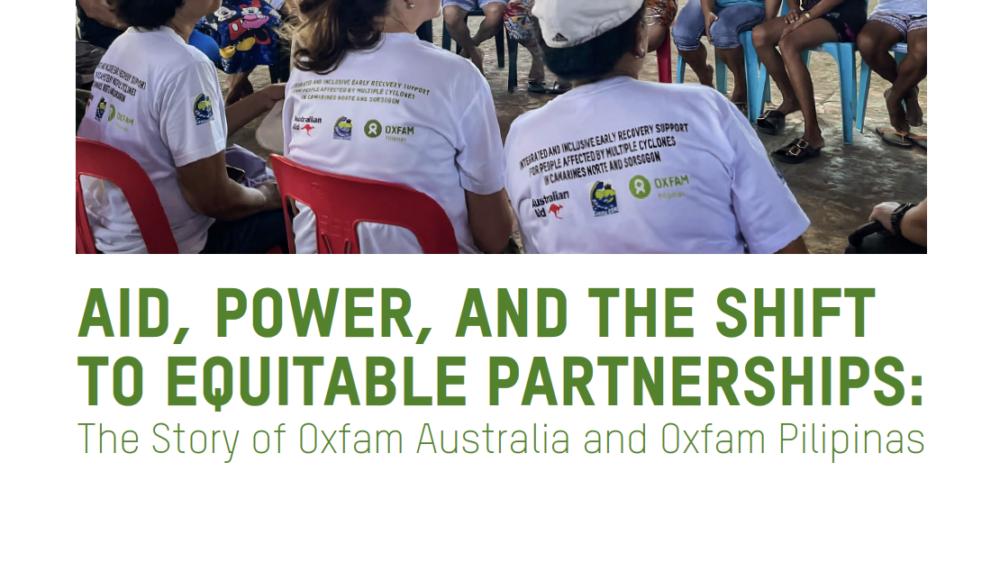
Aid, Power, and the Shift to Equitable Partnerships: The Story of Oxfam Australia and Oxfam Pilipinas
This study explores a potentially pivotal shift within the Oxfam confederation: the successful transition of Oxfam Pilipinas (OPH) toward direct donor funding from Australia’s Department of Foreign Affairs and Trade (DFAT). It captures how OPH built the financial, operational, and governance systems needed to earn donor trust, and how Oxfam Australia redefined its role from […]