climate crisis
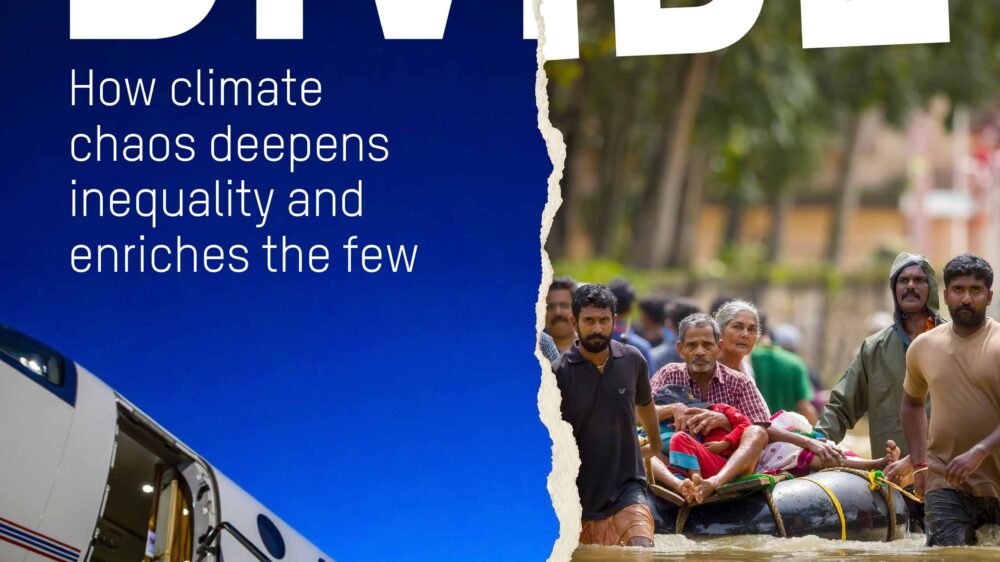
Disaster Divide: How Climate Chaos Deepens Inequality and Enriches the Few
The richest 0.1% (8 million people) globally emit more than the world’s poorest 44% (3.5 billion people) combined. They emit more than three times as much as the entire population of sub-Saharan Africa (1.3 billion people). The carbon pollution of the richest 1% is directly contributing to increased climate disasters such as floods, fires, droughts and food crises. Their yearly emissions will cause an estimated 1.9 million excess deaths from heat.
Act Before Impact: Building Inclusive Anticipatory Action Capacities of Local Government, Humanitarian Actors and Community Leaders
The toolkit provides a structured curriculum for local governments, civil society organizations, and community leaders to plan and implement anticipatory action before disasters strike. It details the use of impact-based forecast triggers, inclusive and community-led approaches, and conflict-sensitive practices to guide early interventions. Covering legal frameworks, risk assessment, and operational tools, the guide aims to help practitioners design and deliver effective, equitable responses in the critical window before impact.

Patterns and Changes in the Utilization of Barangay Disaster Funds: Evidence from Selected Communities in Eastern Samar and Catanduanes
Barangays are the first line of protection when disasters strike, yet incomplete utilization records, fragmented government oversight and limited technical capacity can prevent disaster funds from being used strategically to protect communities. Focusing on 12 barangays across six municipalities in Eastern Samar and Catanduanes, this study examines how Local Disaster Risk Reduction and Management Funds […]

An Amon Lamrag: Mga Istorya Han Pagbabag-o Ha Hilabaan Ngan Tikling
This participatory storybook grew out of a five-month journey with the members of the Hilabaan Women’s Association and the Linao Women Fish Vendor’s Association from Eastern Samar. Together with researchers from the College of Development Communication (CDC) of the University of the Philippines Los Baños and Oxfam Pilipinas, they shared their stories, reflected on their experiences, and helped enlighten what has changed in their lives and communities with electricity from renewable energy.
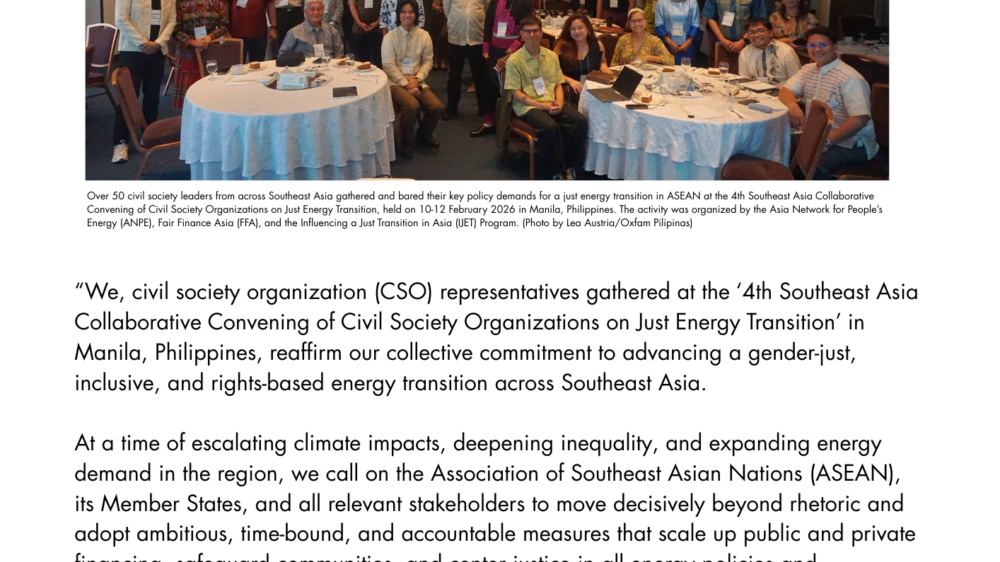
COMMUNIQUE: 4th Southeast Asia Collaborative Convening of Civil Society Organizations on Just Energy Transition
Civil society groups from Southeast Asia called on the Association of Southeast Asian Nations (ASEAN) member states and their energy ministers to “open their hearts to justice by putting people and gender equality at the center of energy governance and planning for a just and inclusive energy transition (JET) in the ASEAN region”.
Guiding ASEAN’s Just and Inclusive Energy Transition: ANPE’s Statement on the APAEC 2026-2030
The Asia Network for People’s Energy (ANPE) congratulates the ASEAN Member States and the ASEAN Centre for Energy (ACE) on the publication of the new ASEAN Plan of Action for Energy Cooperation (APAEC) 2026–2030 last 15 October 2025.
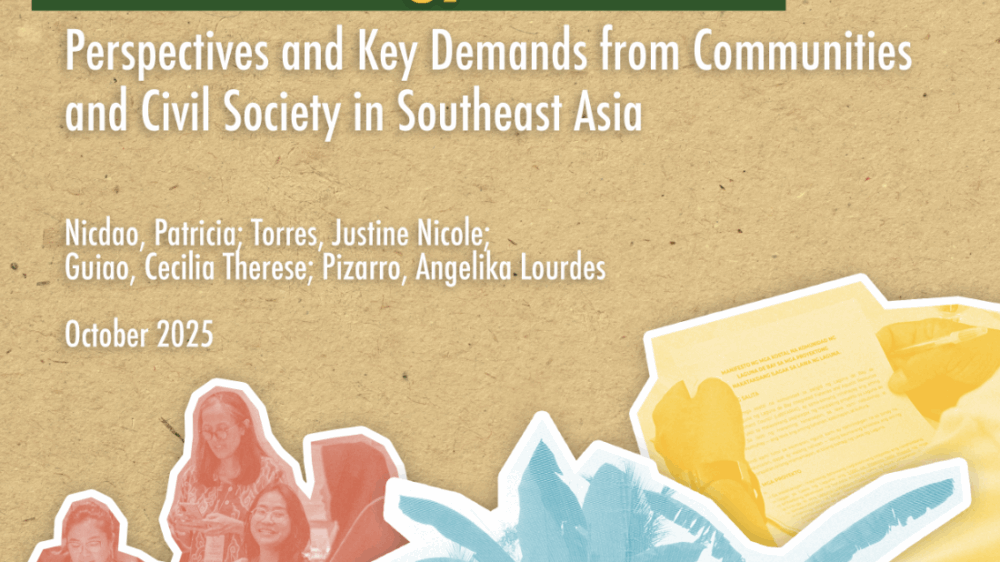
Socially Accountable Governance in Just Energy Transition (Interactive)
This report examines progress, gaps, and opportunities that exist in the intersections of governance, justice, and energy transition in Southeast Asia by examining the role of Social Accountability (SAcc) in utility-scale energy transition projects. Download this compressed interactive copy. The report is also available in full resolution and through an executive summary.
Socially Accountable Governance for Just Energy Transition
This report examines progress, gaps, and opportunities that exist in the intersections of governance, justice, and energy transition in Southeast Asia by examining the role of Social Accountability (SAcc) in utility-scale energy transition projects.
Climate Plunder: How a powerful few are locking the world into disaster
The report, Climate Plunder: How a powerful few are locking the world into disaster, presents extensive new updated data and analysis which finds that a person from the richest 0.1% produces more carbon pollution in a day than the poorest 50% emit all year. If everyone emitted like the richest 0.1%, the carbon budget would be used up in less than 3 weeks.
Climate Finance Shadow Report 2025: Analysing progress on climate finance under the Paris Agreement
The Climate Finance Shadow Report presents analysis of North-South climate finance flows and assessing progress towards the $100 billion commitment to inform climate finance under the New Collective Quantified Goal (NCQG). Oxfam reported on the progress of this commitment in 2016, 2018 and 2020 and 2023. This year’s report, which is co-published by Oxfam and […]