- Version
- Download 1
- File Size 1.77 MB
- File Count 1
- Create Date June 1, 2026
- Last Updated June 1, 2026
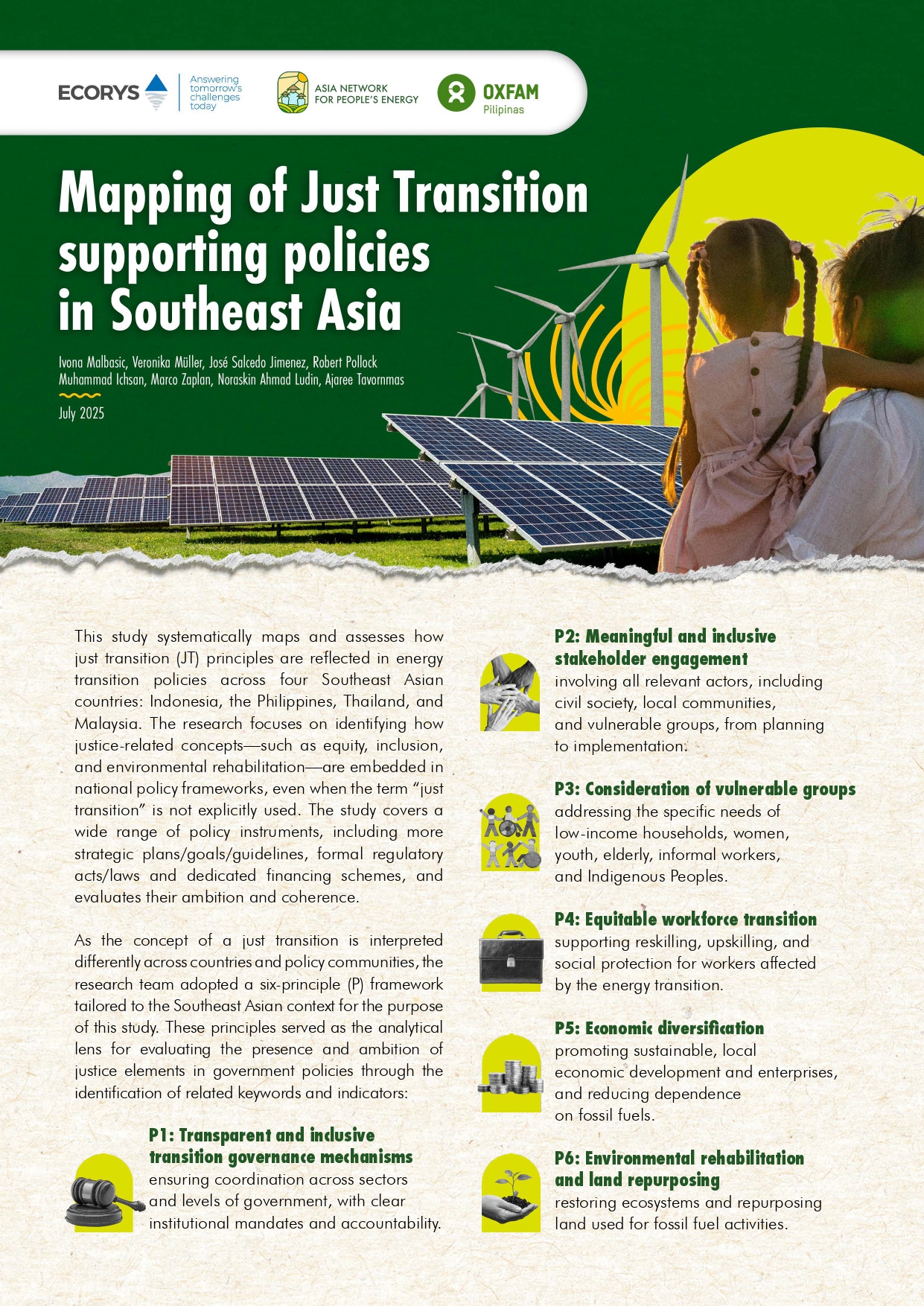
As the concept of a just transition is interpreted differently across countries and policy communities, the research team adopted a six-principle (P) framework tailored to the Southeast Asian context for the purpose of this study. These principles served as the analytical lens for evaluating the presence and ambition of justice elements in government policies through the identification of related keywords and indicators:
- P1: Transparent and inclusive transition governance mechanisms – ensuring coordination across sectors and levels of government, with clear institutional mandates and accountability.
- P2: Meaningful and inclusive stakeholder engagement – involving all relevant actors, including civil society, local communities, and vulnerable groups, from planning to implementation.
- P3: Consideration of vulnerable groups – addressing the specific needs of low-income households, women, youth, elderly, informal workers, and Indigenous Peoples.
- P4: Equitable workforce transition – supporting reskilling, upskilling, and social protection for workers affected by the energy transition.
- P5: Economic diversification – promoting sustainable, local economic development and enterprises, and reducing dependence on fossil fuels.
- P6: Environmental rehabilitation and land repurposing – restoring ecosystems and repurposing land used for fossil fuel activities.
To better understand the current state of play in the policy landscape in support of a just transition across Southeast Asia countries, this study includes a systematic mapping of government policies across Indonesia, the Philippines, Thailand and Malaysia and an assessment of how different justice principles have so far been mainstreamed into policies about the energy transition.
Access the full study including the key findings from each participating country and the recommendations by reading the full report.
This study was conducted and written by Ivona Malbasic, Veronika Müller and José Salcedo Jimenez (Ecorys) and Robert Pollock (Regional Development Solutions Limited), with support from local researchers based in Indonesia (Muhammad Ichsan), the Philippines (Marco Zaplan), Thailand (Ajaree Tavornmas) and Malaysia (Noraskin Ahmad Ludin).